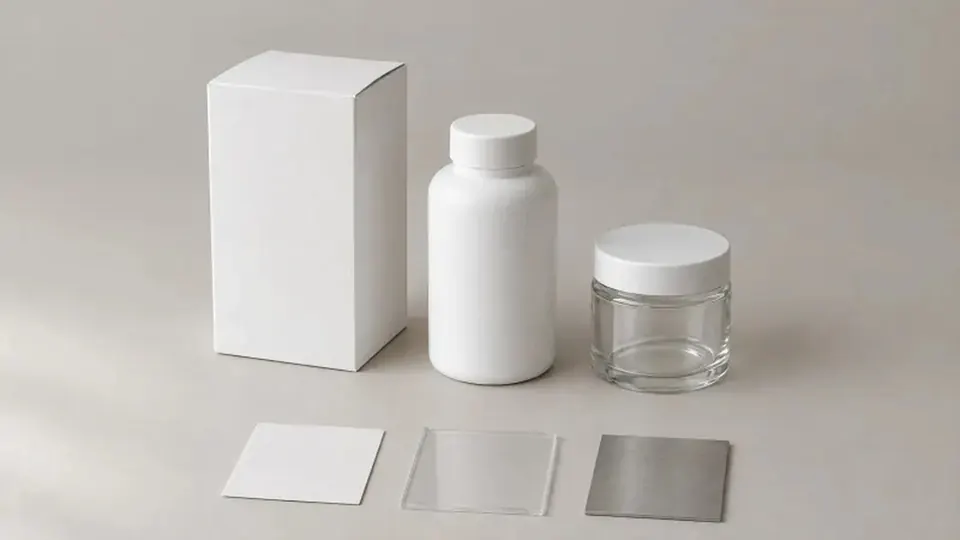
Three things decide which signature to use: the surface material, the application point on the line, and the conditions the product goes through over its shelf life. Whether a signature can be read, and whether it lasts, both depend on the surface. A signature that reads for years on a glass bottle can weaken on foil within a few months. That is why the choice is settled by a trial on a sample of the actual product.
How does the surface affect the signature?
- Adhesion: porous and glossy surfaces do not bond with the signature in the same way.
- Background: the surface's own luminescent behaviour can make reading harder.
- Wear: how the product is handled sets how long the signature lasts.
- Downstream processes: lacquering, sterilisation and heat treatment can affect it.
How do board, coated surfaces, glass and flexible packaging behave?
Absorbent board draws the ink in. The signature spreads, contrast drops and the reading distance shortens. A carton carries one more risk: the surface is stable, but cutting and gluing can run straight across the signature.
A coated surface holds the signature on top. Lines stay sharp, but the signature is exposed to scuffing.
Glass and metal absorb nothing. The issue here is reflection, which narrows the angle at which a reader can be held.
Flexible packaging bends, stretches and folds. Because these movements can distort the signature's geometry, it is placed on the area of the product that deforms least, and fold lines are excluded from the start.
What conditions should the trial cover?
The trial runs in this order: the signature is applied to a product sample, read, then put through the processes the product will face and read again. A first reading on a lab bench is not enough. Packaging waits in a warehouse, vibrates in a truck, takes on moisture in a cold chain and sees light on a shelf. If the signature has to read months later, the trial has to include those conditions.
Why does the line come into it?
Even when the surface suits, the application point has to fit the line speed and the stations already in place. A signature that can be applied at the printing step is usually a better fit than one that needs its own station: the line keeps running and the investment stays small. If surface, line or reading scenario is left out of the assessment, the solution will not perform as expected in the field.
What if the packaging is already fixed?
For most brands the packaging decision has already been made on marketing, cost and shelf-life grounds. The job then is to measure which signature holds on the surface you have.
The Lumvex signature is applied at an existing printing or coating step. From board, labels and foil to metal parts and coatings, a different carrier is used depending on the surface. Whether the signature sits on the box or on the product itself is a separate decision, covered in our post on UV ink.